
a red-ball warm-up game will be the most welcome distraction for Virat Kohli and his men as a precursor to the two-match Test series starting next week.

How to manage China's rise and mould its behaviour will be one of the biggest diplomatic challenges facing New Delhi in the coming years, says Harsh V Pant.

India will surely fancy their chances of an encore, at the M Chinnaswamy Stadium.
It is a blatantly illegal and no holds barred war against the Indian State, against the idea and existence of the Indian democracy and must be dealt with an iron hand.
It's time New Delhi gives some clarity to its Libya policy so as to secure its energy and business interests in the north African nation, says Harsh V Pant
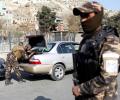
Cut off from the world and having to contend with an orthodox and repressive Taliban government, Afghans are facing the brunt of Pakistan's decades old policy of nurturing militant groups, note Harsh V Pant and Kriti M Shah four months after the Taliban took Kabul.
A Washington-Tehran rapprochement will allow India greater strategic space to pursue its diplomatic interests and as the situation in Afghanistan continues to unravel, this will be useful in shaping the regional environment to India's advantage, says Harsh V Pant.

Images from the second Twenty20 International between India and England, in Ahmedabad, on Sunday.
As Iran and Pakistan move ahead with the gas pipeline project now, India's best option would be to wait and watch to see if the rhetoric of the "peace pipeline" actually matches the ground reality of energy security in its neighbourhood, says Harsh V Pant.
India needs to be aware of the potentially catastrophic implications of the collapse of governing authority in Pakistan. A boost to fundamentalist forces in India's neighbourhood will have some serious consequences for the utility of nuclear deterrence in the subcontinent, says Harsh V Pant.

China seems more willing to co-operate with India over Afghanistan, but New Delhi should step carefully, says Harsh V Pant
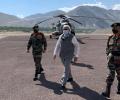
As the China factor enters the body politic of India with greater potency, its consequences will certainly be far-reaching, note Harsh V Pant and Vinay Kaura.
The United States-India relationship stands at a serious inflection point. The two sides need to start thinking seriously about bringing it back on track, notes Harsh V Pant.

Indian defence diplomacy will have to play an increasingly important role as it tries to emerge as a credible strategic partner of the regional states. Neither India nor other regional states have incentive to define their relationship in opposition to China. Great power politics in the region have only just begun, says Harsh V Pant
Berating New Delhi for abandoning the cause of democracy in Myanmar ignores the strategic compulsions for doing so, says Harsh V Pant
Of all recent Japanese leaders, new Prime Minister Shinzo Abe has been the most enthusiastic about the future of India-Japan relationship and gave it an entirely new dimension. New Delhi now has a chance to greatly improve its ties with Tokyo. It must seize the moment, say Harsh V Pant.
India needs to be aware of the potentially catastrophic implications of the collapse of governing authority in Pakistan. A boost to fundamentalist forces in India's neighborhood will have some serious consequences for the utility of nuclear deterrence in the sub-continent, says Harsh V Pant.
If India fails to swiftly capitalise on the propitious political circumstances in Bangladesh today, it will be damaging its credibility in the region even further, says Harsh V Pant.
India and Indonesia have a vested interest in ensuring that China's hegemony in the region does not go uncontested, says Harsh V Pant.

Images from Friday's second One-day International between India and Australia, at the Saurashtra Cricket Association Stadium, in Rajkot.
India's candidature for permanent membership of the UN Security Council will be taken seriously only when it becomes a global economic and military power, able to protect and enhance its interests unilaterally, argues Harsh V Pant.

'India has ramped up infrastructure on its side, so the Chinese military is finding Indian soldiers in locations where they are not used to seeing an Indian footprint,' points out Harsh V Pant.
Though Obama's second term will be very much like his first in so far India is concerned, New Delhi has significant stakes in almost all the issues which will be the focus of Obama's second term, says Harsh V Pant.
India is confronted with a rapidly rising China and all its attendant consequences, says Harsh V Pant
It is imperative that India starts re-assessing its options and think clearly as to what India can do to preserve the balance of power in the Gulf region, writes Harsh V Pant.
The extent and nature of India's role in the ongoing turmoil in West Asia must be defined primarily by its strategic interests in the region. Few are, however, sure if New Delhi has any idea about its regional strategic interests, says Harsh V Pant.
India has a government that has no strategic vision, a defence minister more interested in maintaining his 'clean' image, an armed forces leadership that is not interested in cleaning the mess within. Is it any wonder then that India presents itself as a sitting duck to its adversaries? asks Harsh V Pant.
It's highly unlikely that China will give up playing the Pakistan card vis-a-vis India anytime soon. Indian policy makers would be well advised to disabuse themselves of the notion of a Sino-Indian rapprochement. China doesn't do sentimentality in foreign policy, India should follow suit, writes Harsh V Pant.
The deteriorating regional security environment and the rising tide of Islamist radicalism in Pakistan might just force Beijing to change its course towards India, says Harsh V Pant.
'The defence capability differential between China and India is rising at an alarming rate. This will continue to constrain India's rise as a major regional and global player of any significance.'
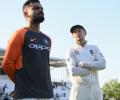
Defeated India skipper Virat Kohli took some comfort from a 4-1 drubbing in England, saying the series had revived Test cricket.
Regional rivalries will only intensify if the perception gains ground that the security situation in Afghanistan is deteriorating. India will have to ensure that it does not lose out as in the past as new realities emerge in the region, says Harsh V Pant.
'Indian policy-makers need a realistic assessment of what China's growing assertiveness means for India.'

Delhi Capitals have never reached the IPL final, never made the top-two, and ventured into the top-four for the first time since 2012.
India should carve out a policy response that protects India and its interests from the negative externalities of the US strategy in Afghanistan, writes Harsh V Pant.
The larger issue behind Jairam Ramesh outburst is about the lack of foreign policy institutionalisation in India. India doesn't really have a China policy and so various departments deem it fit to put their own spin on Indian's ties with China, writes Harsh V Pant.
At a time when the US is finding it extremely difficult to deal with the 9/11 mastermind, Khalid Sheikh Mohammed, within its judicial system, the way India has dealt with Kasab is reflective of the maturity of Indian democracy and its judicial system, notes Harsh V Pant.
'Despite his noble intentions, Manmohan Singh is singularly failing to either manage the country well or to provide a vision for the nation's future. He may be a nice man, but India needs an effective prime minister.'
The China-Pakistan partnership serves the interests of both partners by presenting India with a potential two-front theatre in the event of war with either country says Harsh V Pant.

Vajpayee had always felt that India must act with conviction and panache. He decided that, irrespective of the attendant risks, he would undertake what many felt was a precarious course. A fascinating excerpt from N K Singh's Portraits Of Power: Half A Century Of Being At Ringside on Atalji's 96th birthday, December 25.
